
The first printers used wooden hand presses, probably based press on those used for making cheese, wine or olive oil. The design remained the same for around 350 years, apart from the addition of some metal elements. The forme of type was placed horizontally in the bed of the press, a sheet of paper was fixed in a parchment covered frame called the tympan, and the margins protected by a cut out sheet called a frisket. Once the ink had been applied to the printing surface, the tympan and frisket were folded down to lie flat over it, and the bed was slid under a flat plate (platen) which was attached to a screw. The pressman pulled on a bar, which acted on the screw and lowered the platen onto the paper and type: the platen was usually only big enough to print on one half of the sheet at a time, so bed of the press was adjusted for the second half to be printed. The sheet was then removed and allowed to dry before the second side could be printed. The amount of pressure that could be applied in this way was limited by the strength of the wooden frame.
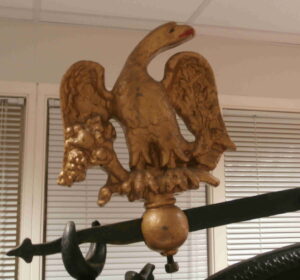
One of the earliest improvements in letterpress printing at the start of the 19th century was the introduction of iron presses. One of the earliest was the ‘Stanhope’, named after its inventor Earl Stanhope. The Columbian was invented by George Clymer in Philadelphia in 1816, though it proved to be more popular in the UK. The Albion press was developed in London in 1822 by R W Cope. Iron presses could withstand greater force which was exerted on the platen by a more powerful range of levers, thus enabling the printing of larger sheets with a single pull.
Another innovation from early in the 19th century was the use of cylinders to provide the impression, rather than a platen. The cylinder rotated over the printing surface as it moved forwards but was lifted away as it moved back so that the sheet of paper could be changed: this type of press was known as a ‘stop-cylinder’ printing machine. ‘Two-revolution’ machines, in which the cylinder continues to revolve, making one revolution to print the forme and another (in a raised position) while the forme returns, and the ‘single-machine’ in which the cylinder also revolves at constant speed but only makes half a revolution for each movement of the bed. The Wharfedale press is probably the best known type of ‘stop-cylinder’ machine: it consists of a travelling flat bed holding the forme of type, which is passed under inking rollers. The machine and its name were never registered, and many firms produced versions of the Wharfedale. Updated models were still in production towards the end of the 20th century.
Thomas Nelson, son of the founder of the Edinburgh firm, developed a rotary press which was demonstrated at the Great Exhibition of 1851. However, the machine was never patented, so its inventor did not benefit from the many versions which followed. The machine was fed by a web of paper, and the printing surface was formed by curved stereotype plates mounted on cylinders. The printed paper was passed under a serrated knife which cut the web into sheets. The original press was shown again at a trade fair in Leipzig, which led to it being impounded during the First World War (it was returned in 1919). It is now on show in the Museum of Scotland in Edinburgh. Newspaper presses were based on these principles for a hundred years.
In the 19th century the original flat-bed press was developed into the modern sheet-fed flat-bed or platen presses. The flat bed was no longer necessarily horizontal, but might be sloping or even vertical. The sheets of paper are still held in place by tympan and frisket as in the earliest times, but on a steel slab, enabling the use of greater pressure. The forme and the surface to be printed are brought together for printing by mechanical action. Smaller presses were operated by hand, using a system of levers, and some larger ones by a treadle action, such as the Franklin press which originally made 1856.
The Miehle press originated in 1887, invented by Robert Miehle in Chicago, was a two-cylinder machine, which turned out to be especially appropriate for process work, and has been much developed since its first appearance. Other models have since been developed and exported widely. Later models have included vertical and two- revolution versions, and there are also models suitable for two-colour printing and high speed fully automatic models.
As printing machines became more complex a whole industry supplying machinery to the trade grew up. As a major centre of the printing trade, Edinburgh was also home to a number of these firms as well as firms supplying machines to allied trades such as paper makers. Well-known printing-press makers include Thomas Long and Patrick Ritchie.
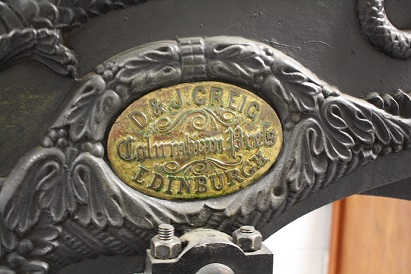
The third edition of Kelly’s Directory of Stationers, Printers, etc, published in 1880, not only lists printers, publishers, bookbinders and stationers but also includes many companies making everything from ‘Bookbinders’ Thread’ to ‘Paper Making Machines’. Some of these firms were large operations and supplied printing firms throughout the world, including John Greig & Sons (previously D & J Greig), of Fountain House and the paper makers’ engineers companies Bertrams of Sciennes and James Bertram & Son at the Leith Walk Foundry.
Greig’s made presses for printers, bookbinders and lithographers, and their output included envelope making machines, copying presses and numerical printing machines. Other companies who were based near Greig’s in the Fountainbridge area of the city were Somerville & Crombie who also made presses for the printing and bookbinding trades, as well as papermaking machinery, Walker & King who supplied the papermaking industry from the Caledonian Engine Works in West Fountainbridge. Seggie & Co were based further east in Broughton Market.